border="0" />Paramyxovirus Basics
Pigeon flyers around the world have all heard of paramyxovirus or PMV. This is a viral disease that is not to be confused with the bacterial disease paratyphiod caused by Salmonella typhimurium. PMV is caused by one of the serotypes of PMV1 viruses which happens to be closely related to another PMV1 virus that causes Newcasle Disease. We will mention this again when it comes to vaccination. PMV first started in the late 1970′s in the middle east and has since been found everywhere that pigeons are raised.The virus is not very tough and dies quickly in the environment. Once a bird is infected it will shed the virus in the droppings and other secretions for three weeks. Between exposure and clinical signs, however, can vary immensely, from a few days to several weeks. This can be a big problem in futurity lofts when YB’s are shipped that are shipped that are infected and shedding the virus, yet are not showing clinical signs. They can have an entire loft exposed before you ever know you have a problem.
Clinical signs are primarily related to two organ systems. The kidney and the nervous system. This virus ALWAYS causes an inflammation of the kidney called interstitial nephritis. When this occurs the white portion of the droppings changes to water and you often find puddles of water on the perches. Within that puddle will be NORMAL fecal material in the form of green or brown “worms”. This is NOT a true diarrhea since the fecal material from the intestine is normal. Since the kidney changes are uniform in the flock of infected pigeons, the kidney is the organ of choice to send to the lab for diagnosis. The changes in the kidney seen under the microscope, when coupled with clinical signs, provide you with a pretty sure diagnosis. These watery droppings can persist for 2 to 3 months after infection in a flock of pigeons. The second organ system involved is the nervous system. The two main signs we see are nerve paralysis shown as a lameness or dropped wing, or torticollis ( twisted necks). When this disease 1st hit the scene the neurological signs were very prevalent. Recently, however, these symptoms only seem to show up in 10 to 20% of the birds at the most. Most pigeons with the neurological signs will recover if they can eat and drink. Therefore, if you have neglected vaccination and you get this bug in your loft you don’t have to destroy good pigeons. Just make sure they eat and drink and you will have the vast majority come back to normal, even to race again.
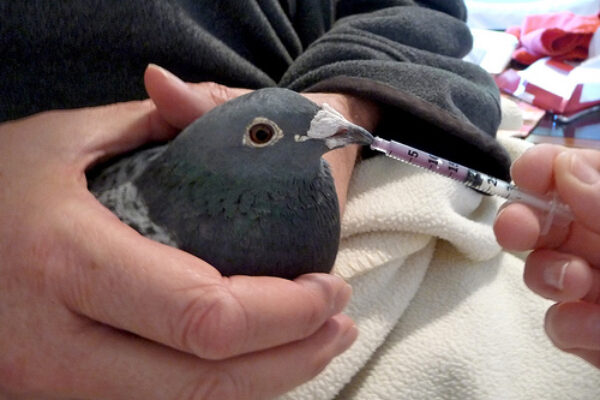
Vaccination for this disease is critical since there are only two types of unvaccinated pigeons, those that have the disease and those that are going to get it sometime. You may have been lucky so far but you will not be forever. By far and away the only PROVEN method of vaccination is to use the injectable pigeon PMV vaccine. There is on made in the States by Maine Biological Labs and several in Europe. Unfortunately, a lot has been said about the use of the chicken “LaSota” vaccine available in the U.S. and Canada. This is NOT a pigeon virus, and is made to inoculate chickens against Newcastle disease which we mentioned earlier. It has been variously promoted to be dripped in the eyes, the nose, or placed in the drinking water. This vaccine will in no way harm your birds, but EVERY study has shown it to be ineffective. I personally have had several lofts in the states send in PMV infected birds that were inoculated with the “LaSota” vaccine and yet still had the disease. The injectable vaccine has also been incriminated by some excellent flyers as harming performance. My experience with the injectable vaccine in my loft and many other ALL-AMERICAN lofts is that it does NOT HURT PERFORMANCE. In short, if you use the “LaSota” type vaccine and your birds get sick, it is your fault, you have been warned. In fairness to the “LaSota” vaccine, many flyers use it as an immune stimulant in the water before a big race with excellent results. I personally have not had experience in that area, I have never used it to know.
Treatment for PMV is only symptomatic. NO drugs that you can give the pigeon will kill the virus ( without killing the bird). Simply do the following:
Make sure infected birds eat and drink Make sure that other diseases are not present, cocci, worms, canker, ect. If 2nd infections like E. coli show up, treat with the appropriate antibiotic base on cultures at the vet.
So, in short, what does the pigeon flyer need to know about PMV.
It is out there and vaccination with the injectable vaccine is critical. Symptoms primarily are watery droppings and neurological signs. Infected birds usually survive with supportive care.
Remember, PMV is a terrible and devastating disease for the pigeon fancier to deal with. But, there is NO reason to ever have to deal with it because of an effective vaccine.
Paramyxovirus Virus Basics By Dr. Steve Weir DMV
Sign up for the Pigeon Insider Newsletter, click here to learn more.
border="0" />Related Articles:
Featured Product - How to Breed, Race and Win with Racing Pigeons
Have you ever wondered why the same fanciers always seem to win?
It's time you learned the amazing secrets that keep these top fanciers winning race after race. It's time you were let in on the secrets they use to turn their pigeons into super-fast, homing rockets (even their worst pigeons are winning races!).
You will discover how to really understand your birds, how to select the ‘winners’, how to exercise and train them... What is the best diet, how to ensure the strongest eggshells... the best breeding pairs and much more.
You’ll find everything you need to know to become a great pigeon fancier inside this formidable eBook:
You'll discover the tightly kept secrets that ace pigeon fanciers use to breed race winning birds that consistently net them those cash prizes. Follow in the footsteps of the professionals and start seeing your pigeons at the top of the leaderboards.
What are you waiting for?


I had a very hard time last summer when most of my young birds were infected with Paramyxo Virus.It took me a few weeks before I could identify the virus,because the first signs were watery droppings and so I treated all my pigeons against intestine disease.My birds got worse every day and I also had some mortality as well.After some time I had single birds loosing their balance and this was the time when I was sure that I had the virus in my loft.I started a ten day course of Batril followed with seven days of probiotics.My birds showed immediate improvement,but those birds which were highly infected and twisting there head and loosing balance had to be destroyed because they did not get any better.
أشكر للحصول على المعلومات الخاصة بك ،
أنا لم ألتق هذا الفيروس من قبل ، my name is ahmed iam forum maroccain of the city el jadida
Newcastele الـتواء الـعـنـق
الاعراض
اسهال مائي مع التواء الرقبة الى اسفل وعدم توازن الاعصاب – فقدان في الوزن وهزال الجسم
موت الفراخ الصغيرة في اعشاشها وكذلك عدم نمو الريش بانتظام عند الصغار مما يجعل نهاية الريش متقصف بسبب المرض
وهو من اخطر الامراض التي تصيب الحمام لسرعة انتشاره بين الحمام في الحظائر
العلاج
ليس هناك علاج فعال 100% ولكن يوجد علاج وقاية من هذا المرض قبل الاصابة به وهناك بعض الاحتياطات واجب العمل بها كما هي
الحمام المصاب بعيدا عن الحظائر التي غير مصابة
اعطاء جميع الحمام مضاد حيوي ودواء لحماية المتبقي من المرض لمدة 3 ايام متتالية واملاح مع فيتامينات وبالخصوص الصغار
تطعيم الحمام سنويا بالتطعيم المناسب لهذا المرض والتركيز على تطعيم الفراخ الصغيرة عند بلوغها 3 اسابيع من العمر ونقلها الى حظيرة خالية من المرض
ملاحظة -هناك علاج آخر متداول بين الهواة وهو ان يبعد الحمام المصاب الى مكان بعيد عن الحمام الغير مصاب وينزع الريش من الرقبة من جانب الالتواء ويطهر المكان بمطهر مع أخذ ابرة نظيفة مطهرة والتقر في المكان المنزوع منه الريش لاخراج الدم الفاسد وبعد انتهاء العملية يوضع مادة مطهرة على الجرح وبودرة مضاد حيوي وتركه في مكان مع ملاحظته واعطائه فيتامينات واملاح مع الغذاء
ونسبة نجاح هذة العملية معقولة جداً
Hi This has just stuffed up our Racing season ,we had 3 races left but the stopped us racing for this season.There has been some casess in Australia
mediciane for pmv either in form
my pigeon suffering by parmyxovirus.i had take country medicine,then i had try with enroflaxcine.and vacinated with pottasium chloride due to non avilablity of pottasium arsenite in india.but the bird not recoverd.hand feeding. any person who know the medciane or vaccination pls cooment.
You can read these here: http://www.saddlehomersusa.com/
“Treatment for Paramyxo virus (PMV) symptoms
Surprisingly the symptoms of Paramyxo virus infection can be cleared up by treatment with Baytril. The concentration is 2.5% and 0.2 ml is given once daily by mouth for ten days. Nothing much happens for 7 days, after which recovery is dramatic.
I have treated four birds, in three cases with complete success. One had been totally incapacitated, lying sprawled on a hot water bottle for 6 weeks before I came across this treament. In the fourth case, after treatment the bird tossed her head back occasionally when feeding but otherwise was fully able to cope with life outside. Wet stools may persist for some time but appear to return to normal eventually (weeks to months). With two of my birds there was a long period of diarrhoea before that side of things returned to normal.
Recovery was not spontaneous – it was entirely due to the administration of Baytril. My first three birds languished for 6 weeks before treatment and, apart from learning workarounds to the problems of feeding, showed little or no sign of recovery.
Why it works is of course a bit of a mystery! Medics will know that antibiotics have no effect on viruses. A vet gave me Baytril because he thought that the disorientation might be due to an inner ear infection. Another vet later came up with the plausible suggestion that virus infections reduce the effectiveness of the immune system and so may open the way for opportunistic bacterial infection. With paramyxo this bacterial activity would affect the central nervous system. After treatment birds appear to acquire immunity and pass this on to their young – two of my cases paired up and none of the dozen or so offspring developed symptoms.
Paramyxo symptom checklist:
Disorientation – bird is unable to judge position of objects properly.
Loss of control over head and neck movements.
Stools consisting of a pool of clear liquid surrounding small amount of distinct solid matter.
Erratic flight with sudden changes in direction for no reason. Near objects (eg roofs) there is characteristic fluttering and hesitation as if bird is unconfident.
Misjudged landings.
In bad cases or under stress bird may crash almost immediately after takeoff; indoors a bird will crash into walls or back onto the floor.
Head shake – head movements appear exaggerated and stiff and are followed by a brief period of Parkinson-like tremor. The bird seems to have difficulty focusing on things.
Neck torsion – usually seen in worse cases. When the bird attempts to preen or feed it loses control of the movement and the neck twists over the back or under the chest. The head may even be held upside down.
Feeding problems – the bird cannot judge the position of food and/or loses control of its head and neck movements, the beak slipping sideways across the ground and missing the food altogether. Sometimes after a bird has successfully taken a food item the head is tossed back as if there is difficulty swallowing.”
Raymond Julien,
thanks for the information Mr. Julien, i’ve encountered that virus before but due to lack of information, i was forced to kill those birds with such virus. All i know is that… it was an air born disease w/c can easily be transferred to other birds.
Thank for your information,
I never met this virus before, however i read the article at http://www.saddlehomersusa.com/ wrote by Raymon Julien. I think it’s useful.
I dont remember getting this virus and never heard anyone talking about it here in australia, I do know that nobody here in this town vaxinates for it.
I look forward to ur email each week and feel very privliged to recieve them thanks and i hope u get out of it what u put in.
Jeff
thanks again sir chris .. this post is verry informative..
i loke this post! god bless you and good luck to your pigeon rae.
Thanks for the article on PMV.I have never had this infection in my loft and have never heard from anyone that has had it.I read about this infection in many overseas magazines,but have never heard of anyone here in NZ treating their birds for it.
thanks learning more day after day thanka to all
good day! thanks for sharing to me and i know how to medicate the pigeon if sometimes having a PMV so i’m glad to get the best idea.. thanks sir chris.. pls send at my email add. what is the other related pigeon againts PMV and other disease pigeon,, pls give me the right treatment od any disease pigeon.. thanks. god bless and more power.
if you touch the sick bird can it harm you someone knows carlosarock7ds83@YMAIL.COM
i once got paro and i would recomend to get your young birds vaccinaed because it clears you out and for £20 per year its not worth the hassle i innoculate at 28 days old youngbirds never had a problem in last ten years paulpashley36@yahoo.co.uk /blue diamond lofts
Is There any Home remedies , such as Apple Cider Vinegar That can Help as well ? Garlic In The water ? Etc……
thanks for the info. chris!
keep up the good job…
In my opinion,I would rather sacrifice a good bird and burn it right away after i notice a first sign of PMV than to loose the rest of my good birds . I will immediately clean and disnfect the loft as soon as possible to avoid the spread of virus to my loft and other neighboring fancier.In this way damage will be very minimal and virus will be eliminated in a low intensity level.
As for PMV I want to tell everyone my experience. First I am NOT a VET and I am not giving any one advice. I will give every one here a strong warning . PMV your birds because Sooner or Later you will get PMV.
I have had it two times. Once in 1999 when a man brought me 4 barn pigeons to train dogs with. I did not want the birds and put them in a pen with food and water. In 2 days their necks would spin and in a few days more my whole yb race team had PMV. The virus is Air Born and I never touched the birds and did not go near them. They were in a pen 30 yards from the loft. Only 10 birds made it of the 70 I had. Two birds went on to win first place combines.
I had it one more time years later when a stray came to my loft. My birds were 4 months old and I was waiting to vaccinate them. I used Baytril and I gave all the birds a PMV shot to trigger the immune system. I did save many birds and 2 went on to win first place combine races as well as many other races.
I read a article where it is advised to not vaccinate birds till they are 4 months old and their natural immune system is built up. I DISAGREE with such advice. If you wait you risk loosing all your birds.
I follow the directions from Maine Biological Labs with the PMV-1 Vaccine and I vaccinate at 4 weeks old and then one more shot 2-4 weeks later. When I have done this I do not believe I lost any birds later in training . Last year my yb team was flying 5 hours on wing by the time November came.
4 years ago I waited to PMV 2 team of yb . One team was flying 2 hours on wing and the older team 2-5 hours on wing. Both teams STOPPED flying after giving the shot and it took 2 weeks for the older birds and 3 weeks for the other birds before they resumed their normal flying time. They were not feeling good from the shot.The second booster shot had no effect.
Now MY WARNING and I do not know the correct answer of how long to wait to resume road work or how far to take them till they get over the shot. But two friends of mine that were racing pigeons and were in a rush to keep training gave their birds a shot for PMV the same weekend I did. I do not race so I was not even road training. You see they took their birds on a 60-70 mile toss the next weekend and one flier loss 25 birds and the other close to 60 birds. The birds I believe need lots of time to recover from being given the shot and also what ever bad feelings they receive from it.
This has been my experience and what I believe to be true .
vaccinate your birds for PMV and protect them for life !
Yours in Sport – James
In this area we consider Young Bird disease the same as Adeno-Coli Syndrome or Adeno Virus as it is called.
Most of the fliers that I know who had Andeno , saw no more than birds throwing up their food.
But I wonder if much of the loss of yb is not due to Andeno by shipping birds to races that are sick with it or going to be sick from Andeno.
I have had YB sickness but I do not race yb any more so mostly never see it. When my birds got Adeno they threw up their food and I just stop flying them until they got over the sickness and I never had any problems from the sickness. I never had birds die from it and do not believe I lost any in training. I use nothing but time off to treat the sickness. But fliers are using two medications I know of to help the birds.
What helps me detect Adeno is the fact that my yb are mostly in a grated box . So if they throw up their food over night I can see the food. Other wise if I did not have such box perch when the birds throw up food others might run to eat it up and I would never know what is going on in the loft.
Hello
Is this considered to be what everyone is calling young bird disease
If not what is young bird disease.Someone with more knowledge then I have
help me out here.
ROYALSLOFT
Thanks for the information about Paramyxovirus Virus. This is the disease that with care and dood treatment can prevent the pigeon from die. However, that also depends to the state of pigeon’s health at the time of disease. I do agree that vaccination is the best way to get out of this killing disease.
To respond to George that has mentioned it is simlilar to paratyphoied, I should say first that there are hudresds of diseases that have similar simptoms, however, there things that can be very specific to one disease. In case of Paramyxovirus Virus as I have experienced the pigeon has a critical watery diarhea that is not the same in Paratyphoied. Whereas in paratyphoied, pieon is losing whieght rapidly with suddden death that is not the case in Paramyxovirus Virus. while in both the pigion is sitting a side with less or very less desire of eating.
Zahir
i have bird that acquire such disease 8 months ago but she is still alive,she eats a lot and have a good eating habits i guess that is why the bird is still alive.the only problem with this bird is the twisting of the neck.is it possible that the neck twisting will be gone or it will remain forever?
rey arceo
Great subject. I have never vaccinated for PMV. this year during my old bird racing season we had alot of new club member who never race before. For some reason my birds got seek real bad. 10 to 20 die the symtoms were as fallow. drinking alot of water, diarrea, fever and in most of the case they die in 2 or 3 days that happen in alot of the lofts. Event some of my breeders die which have now contact with my racers. I medicated just about for everything with no results. this year I willvaccine my birds for the first time.
Thanks for your helpful column on Pigeons / Birds
Thanks for the paramyxovirus article,will it be harmfull to use the vacine 3 or 4
times a season.Paramyxo is a scary lot,rather safe than sorry.
Phillip.(Old Grizzle)
Good heads up Chris,many people still don’t give the shot and it’s an easy thing to do.In your video liberary there is a discription to give the shot in the leg, thats how i do it with no problems.It should be manditory to give our birds both shots as well as the pox vaccine.If all our birds are healthy, then we can all relax and just race pigeons.
terry
I HAVE IN ROMANIAN PLEASE…EVEREONS…
tank you…
Thanks for the article on Paramyxovirus.
makihariomoke@hotmail.com
Graig go to youtube see my video johnglemser maybe it can help you chris greate work
Craig in response to if you have pmv or not. Our race club has never had problems with it till this fall when many of us got it. pmv and paratyphoid will resemble one another. I have dealt with both. I supect you are dealing with paratyphoid as this disease causes more deaths, you may also get boils or lumps on wings and joints. I would treat with baytril for 14 days as this will remove the carier state of this disease from your birds. Beware it is expensive and requires a vets prescription here in the states.
Pmv on the other hand meds will not help, give lots of rest, the birds will drink excesivly, do not deny them water, feed consumption will decline, vacinate as soon as posible to stop the spread. A bird can carry this virus for up to 4 weeks before showing symptoms. Patience is the key to this one birds may spontaneosly recover after 14 weeks. Some bird droppings that where loose may never recover, but I have heard of birds that after recovering have gone on to win 600 mile races. The recovered birds will hav the antibodies to resist this virus a second time. Best advise is to vacinate, needs to be done anually as prescribed.
George,
Thanks so much for your response. I will try Baytril as you recommend. In your last statement you say your “best advise is to vacinate”. Can you recommend what you vacinate with.
Thanks!
Craig
cgaccardo@yahoo.com
It is a killed Virus, from Maine biological labs
IN OUR COUNTRY WE USE ‘R D V K’INJECTION FOR THAT DISEASE.WE VACINATE BEFORE THE RAINY SEASON STARTS.
Hi Devasena,
i need to know where can i get this vaccines for my pigeons..
I suppose my pigeons are infected with PMV-1 viruses, if u have any kind of remedies known, then please reply me as soon as possible.
symptoms
drunk lots of water earlier with green watery droppings,now its not eating anything,looks like depressed, muzzle problems with neck(neck twisting).
Advice me if i can use any kind of vaccines or any medication given through water.
Please do reply to me…
Thanks In Advance..
Ajish.
Thanks for the article on Paramyxovirus. For the past fews weeks I’ve had birds die unexpectedly, horriblbe droppings, and 1 bird who sits on the floor of the loft with his head turned completely around like Linda Blair in the Exorcist! I have tried every remedy to solve this problem. Does this sound like Paramyxovirus? Can you help me with a solution?
Thanks!
Craig
I really enjoy reading about pigeons.I don’t know how you have the time to do this,but i am glad you do.KEEP UP THE GOOD WORK.We need more like you.
Absolutely great articles Chris, You are doing an oustanding job.
Thanks
Bryan Chaisson