Pigeon Feeding – Feeding to Win
During the racing season, the main function of food is to provide the fuel for flying. Our common aim is to provide the racing pigeon with the best fuel for race day. To do this consistently we must have a good understanding of the food itself. The following paragraphs will introduce you to the science (or theory) of feeding, but for racing success you must also become expert at the practice (or art) of feeding. Only practice and observation can teach you the art of feeding, but hopefully the methods of feeding described here can help you find the pathway to feeding success.
Pigeon Feeding – Feeding to Win
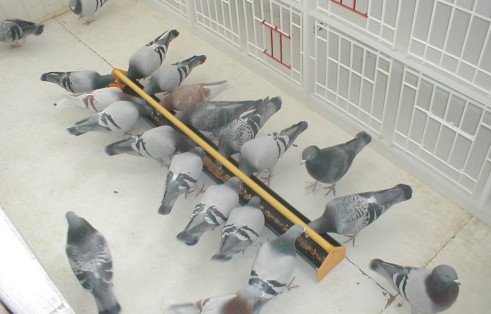
We can only begin the art of good feeding when both the quality of the food is guaranteed and the flock is healthy. A healthy bowel is required before we can test our feeding systems, because an unhealthy bowel fails to deliver the fuel of good grain to the pigeon’s body. Bowel diseases such as E. coli, coccidiosis, worms and wet canker all decrease the amount of nutrients entering the body.
By using the best quality grains and with a healthy race team, the fancier can now think about a racing mix appropriate for his particular family of birds and training methods. The mix chosen must provide a good balance of protein (amino acids) and for this to be achieved at least 8 different grains must be used. After this balance is achieved, the energy content of the mix becomes the most important part of successful feeding.
Pigeon Feeding – Feeding to Win
The feed system provides the race team with the correct energy levels for training and racing. The goal of feeding is to provide the training and racing pigeon with exactly enough (not too much and not too little) fuel (energy in the food) for sustained flight (loft exercise or racing). Of course, the fuel requirements of the training pigeon vary enormously from day to day. It is the constantly changing energy requirements of the competition pigeon that makes feeding such a challenge to even the best fanciers. The competition pigeon will not perform to its fitness level when the “energy balance” is incorrect. The “energy balance” must be assessed short term (daily) and long term (weekly) with fit flocks during the race season, because the fitness level will drop both when too much and too little energy is supplied. During young bird training special attention must be made to prevent depletion of the energy reserves in the liver and muscle.
Overfeeding relative to workload (positive energy balance) renders the race team less competitive because of excess baggage (“leady”). Excess energy is stored as fat with subsequent loss of buoyancy and fitness. It is well to remember that the excess energy of mixes which are too high in protein (legumes) relative to the work load will be stored as fat.
Pigeon Feeding – Feeding to Win
Underfeeding relative to workload (negative energy balance) renders the race team less competitive because of “depowering”. Feed systems low in energy relative to the workload of the race team will result in the depletion of the energy reserves in the liver, fat and muscle.
The fancier can recognise a race team that is in a negative energy balance by the following signs:
No wing flapping in the early morning or after feeding.
Disinterest in leaving loft or toss basket, lower lid laziness etc.
The race team in negative energy balance (inadequate energy intake relative to the workload) is susceptible to illness, especially “respiratory” diseases.
Pigeon Feeding – Feeding to Win
Buoyancy
Most fanciers understand the importance of buoyancy for success, but few understand the best way to achieve this in their race teams. Buoyancy is best achieved by supplying the flock with enough feed (a positive energy balance) to promote vigorous loft flying (or tossing) in order to maximise lean body mass (i.e. muscle) and minimise body fat. Instead many fanciers believe that the best path to buoyancy is to restrict caloric (energy) intake (feed less) in order to lose excess weight and thereby produce the buoyancy that we see with top form. However, buoyancy is not only weightlessness, but also power, and the buoyancy of fitness only comes when lean body mass is maximised. The restriction of calories in an effort to produce buoyancy in fact lowers the fitness level of the flock and renders it susceptible to illness. Severe caloric restriction will cause a loss of not only body fat but also lean body mass (muscle) with the accompanying loss of fitness and power.
Pigeon Feeding – Feeding to Win by Dr. Rob Marshall
Like this article? then you’ll love Pigeon Racing Nutrition Secrets Exposed

Related Articles:
Winning Pigeon Training and Racing Systems
This Comprehensive Guide Uncovers All the Techniques Behind the Most Successful Pigeon Training and Racing Systems” Winning Pigeon Training and Racing Systems Revealed explains all the major racing systems. like Widowhood, Double Widowhood, Natural System, Jealousy and Darkening and shows you weekly preparation activities and strategies. You will know exactly how to prepare and train your birds like the champions. You will also learn young and old bird systems and teaches you proven motivation techniques and strategies to make your birds fly home faster.


Good advise on feeding Chris. The amount of feed you give your birds also depends on how hard you work your birds by road training and weather conditions. I think the main problem comes during the moult by over feeding the birds and they become very fat (inner body fat). Not very easy to break down those inner body fat and by the time they reach their prevered wheight,you already rank low on the scoreboard. The saying is “you already win the races during the moulting “. I however like to read all those comments and find it very interesting. Regards.
I would like to ask a question, my cousin tells me to put water into the food of my pigeons, just like the way they feed their chicken. is it healthy for my pigeons to eat wet seeds/food?
For starter your pigeon is not a chicken . just stick to dry seeds and the best seeds by me is corn . corns make the pigeon healthy and big. but if you want the best try pigeon food yeah … and its not healthy for your pigeon that you keep feeding them wet food .. wet food may lead your pigeon have worms inside on its big tommy!!! .hehe and make shore your pigeon is healthy and maybe buy some vitamins for them .. so that you may race them .. sorry a got carried away from all that but keep your pigeon well……. that all thank you!!!
Hello Sir thanks for good tips satpal
i would just like 2know, how do people get it right 2get ther pigeons loft flying for +- 1 hour? my pigeons do a 5min then they all down panting like crazy..according 2my knowlegde, they healthy and the droppings are nice..could it be my feed? im currently feeding them peas in the morning and barley and sunflower for evening feed(i believe they overweight).because we starting with our racing season in june, iv treated my birds for kanker and im currently busy with cocci treatment.. any advice??
Hi Saeed
Yes your feeding is incorrect. Go to a more commercial base feed that contains about 35% corn/maize. Give them herbal teas to break down the fat and about 2 teaspoons /l water lemon in water every day for about 2 weeks.Then deworm them, some of the commercial dewormers don’t treat gapeworms. They need more carbohydrates in the morning and please don’t feed so much sunflower seeds.
Great to read this about feeding ,i never been much good with feeding so might learn something here.
Fantastic article on feeding as to achieve efficient loft training and ample body mass. I like to remind fanciers not to allow immediate drinking after hard excercise as such practise will harm form and can result in serious set backs. In most part after drinking pigeons are mostly interested in small grains, and it is your management which can allow for balanced intake of grain.
Nice article. I like the very high level informative presentation of the subject. It would be good to include some details to help a young racing fancier who is attempting to understand the ‘Art’ of feeding. Providing an example of a ‘Race’ mix and a ‘Breeding’ mix that could then be used in the “Practice and Observation” steps of the “Art of Feeding”. I actually learned more practical application of the Art of Feeding from those who were kind enough to post comments than I did from the article. But thank you for starting the discussion.
please provide me the some tips of food of racing pigeon in india i have 120 pigeon then what diet i give him for racing
hey chris, how much feed do I give my pigeons when I get them.
hello sir
i am lucky pigeons form india so your e.mail give me satpal singh please send me some tips thanks
the use of barley make feeding easier.because the weather and races differ theres no way that you can measure feed.measure the jug or cup you use to feed.when youv’e fed three quarters of your measurement mix some barley with the balance.watch the birds,keep feeding until they stop picking up the barley.the permanent inclusion of barley(5%) in your mixture can allso make it easier,because you just stop feeding ounce they refuse to pick up the barley.feeding is so much easier if your race team is of similar size and their requirements is the same,but just keep feeding if theres no barley left behind.
thank u for the tip!
thanks chris for nice info about feeding. god bless..
Hey Luis Cargiulo,you said they have your money but no responce from them.. Did you buy something from them? I hear of a lot of scams anymore, I hope this isn’t one of them.
have you raised any of your pigeons
yes freind i am from india i like make fit ot my racing humar pigeon but i dont know good diet pl help me soon
Not real happy with Pigeon Insider-I have sent at least a dozen e-mails to the contactthe me e-mail etc on Pigeon Insider. I have not been able to get into Pigeon insider except for the first time I registered etc. It will not take my user or PW. Almost three weeks later still not reponse from Chris or anyone else but the have my money. Beware I have been slow to critacalit is a shame as there appears to be good info.
There is no phone number to call for help so I have no other alternative except to write this bad review.
yours in the sport -Louie
Hey Luis,
Extremely sorry for the inconvienience
please email me at pigeonracingpigeons@yahoo.com and I will be happy to fix the issue.
Yours in the sport,
-Chris
http://www.pigeonracingpigeons.com
Excellent information about the feeding.
where u from, and where u fly out of im in ga
hi my name is albert i am new the sport but not sure how much to feed my birds
well I am in the new sport too and I definitely am not sure how to take care of pigeons cuz I have not gotten my pigeons yet, so keep up the good work.
Thanks for the great info on feeding Chris! keep-up the good work!
do anybody no how to feed young birds just got them in 4 days ago seem like their going light very young racing homers and a feed program for racing bend racing for 3 yrs no one tell me anything i want to kick there butt pay back please help
In the beginning of this years racing season everything went well. Winning a sprint race but as it got longer the races got tougher,with many losses. Was by no means in the reconing. What went wrong because the feeding stayed the same,training stayed the same, everything? Usually i increase the feed from the time we reach the 550 km mark. What can be done????
Morne with the stress of racing ect ur birds probably become unwell, u probably should treat for respiratory disease.
Birds should feel silky to touch, the droppings should NOT be wet and should have down feathers on them in the morning also as the racing gets longer u need to increase the fat content of the food.
When I first started with homers was 2003 I made sure birds had enough reserve to get back home birds that I lost could have hit a wire or been grab by hawk 12 races only lost 3 birds started out with 30 I had birds at top middle and bottom of the sheet It wasn’t to just resent that I realized by reading pigeon Insider what I was doing wrong every bird at my loft goes out I have my 03 team loft flying and routing just as long as my 2010 young birds most of my birds are in great shape but not all are some are going Thur molt while others are passed it a few sick ones showed up so i will say it again DON’T OVER CROWD YOUR PIGEON…
You might be able to handle things for awhile but seasons change and you have to know how to change with them. It’s real easy to stress a pigeon and not even know it until they start dropping on you.
ROYALSLOFT
ANDY RIVERA
New Zealand land of the Maple pea good quality seed. Barley a must for breeding and racing. Long grain brown rice high in carbs along with Sorghum (milo)
Safflower very high in protein and great as a trapping seed
New Zealand land of the Maple pea good quality seed. Barley a must for breeding and racing. Long grain brown rice high in carbs along with Sorghum (milo)
Safflower very high in protien and great as a trapping seed
hi i m from india can anyone send pigeons to india bcoz i like to have pure breed
Thank you
I mix my own feed there is a web site birdhealth.com.au that has some good formuals I have mixed the stanard and then add more peas and barley to feed my breeders and the young look and feel great and race team is flying good to.
i am new 2 the sport i have have my race team on garvo
iv got my pigeons on garvo i am new 2 the sport is it en good
hi can any one explain the light system for young birds yours in sport gary
I thank you for attention My name azoo of Libya, I’m not involved in racing pigeons, but I like pigeon Ornamental and I have some questions about the disease, I hope that answered me about the most important disease and twisting the neck of the disease not to cure us and I I’m confident in your experience and I hope your help
HALLO
I HOPE YOU CAN HELP!!!
I WANT TO KNOW IF YOU CAN TELL ME MORE ABOUT THE DE NORRA [ DA NORRA ] PIGEONS.IT MUST BE AN OLD STRAIN I BELIEVE FROM BELGIUM. THERE IS FANCIERS THAT STILL DO VERY WELL WITH THEM IN SOUTH AFRICA WHERE THEY CROSS THEM WITH OTHER STRAINS
I HOPE YOU CAN HELP
ADRI STRAUSS
I think you are talking about De Norre
You can read something here
http://www.pipa.be/artikelsnew/gallez/denorreeng.htm
Regards
This pigeons was good for short distance.
NICE INFORMATION ABOUT FEEDING.I BELIEVE THEIR IS A LOT OF WAYS TO GO ABOUT THAT ALL WORK.I BELIEVE IN A MIX WITH A BIG VARIETY AND GOOD QUALITY.FROM HERE YOU CAN ADD FOR SHORT AND LONG DISTANCE RACING AND MOULTING AND BREEDING.
THANKS
ADRI
Feeding is an art most of us do not understand,and believe me I wish i did.Do your homework,Tenmon has it right,get a base mix and adjust as needed.Here’s a heads up, read The New winning & feed to win, two of the books ALL flyers should have.I bet I read the new Winning about 4 times and still find different information I missed.Feeding is by far the toughest thing to do, since we all tend to show mercy (lol) to our birds.Barley is one of your best friends when it comes to feeding your birds.
terry
Gillie:
The feed must be tied to the purpose at hand. That is breeding, moulting, racing, etc.
Try to get a base mix which can be adjusted for any of the above purpose. The base mix should contain a variety of grains with an omega 6:3 balance close to a 1:1. Note that the safflower and sunflower seeds are about 600:1!. Like eating a burger with all the fries biggie sized just before “puropse” at hand. Not good. Also, don’t forget that feeding high fat diets do not equate to birds storing more fats. You can build fats more rapidly by feeding more carbs, eg. corn, than to fill them with a high fat seed. I would have love to see some hemp in the mix.
gille, try to stay away from any cut or cracked grain. try popcorn or solid corn instead
@Rick Savage, what’s wrong with cracked grain feeds?
without the right feed we are fighting a losing battle
fat birds wont win anything either will birds that are starved get the ballance right and you wont be far behind on race day
good quaility malting barley is priceless and keeps the birds honest
regards
peter
http://homepage.ntlworld.com/r.frayne/down.html
You can download a program from this page that helps you figure out your crabs, protein, fat and water for your mixes, I mix my own feeds, found this a very useful tool
Jeff could you email me feed calc pro thanks don campcarp@hotmail.com
Figuring out the right feed at the right time is something I still need to learn. In the meantime I purchased feed that I’m told is too fattening so I’m cutting it 50/50 with wild bird seed. I have 3 more bags and can’t afford to buy much else just yet.
The birds are loft flying roughly every second day but are not ranging as much nor flying as long as they did before the snow came down. They use to fly an hour sometimes two but now about a half hour. They had some respiratory issues due to a lack of ventilation and were medicated and recieved probiotics and responded very well. Ventilation was installed.
I’d like to know more about feeding requirements at different times such as the molt, breeding and racing and the slower times like winter when they loft fly a few times a week when the winds are low and the tempature around 0 Celcius but need extra heat due to the minus 10C to minus 30C tempatures that last for a few months each winter.
Current Feed Mix
Custom Oz Mix conatains – Moisture% 10.6; Protein% 18.4 ; Crude Fiber% 6.30; Fat% 6.81; Carbohydrate% 58.4
( 14 seed types) Hard Red Wheat, Canadian White Peas (trapper peas), Flax Seed, Red Millet, White Millet, Canola Seed, Maple Peas, Buckwheat Seed, Safflower Seed, Malt Barley, White Milo, Austrian Peas, Black Oil Sunflower Seed, Vetch Seed
I mix the above seed 50/50 with the wild bird feed below.
Wild bird feed – ( 6 seed types) ingredients include fine cut corn, fine hard red wheat, white millet, red millet and/or milo and black oil sunflower. Crude Protein, not less than 10%, Crude Fat, not less than 4% , Crude Fiber, not more than 8% , Moisture, not more than 12%
Is this mix in low flying -14C bad, reasonable, good, great?
Thanks… you guys keep me thinking and learning and I have yet to recieve an email anouncing a new article and think, “oh not them again” so good going!
Try mixing your feed with barly, it’s one of the best things to feed period.Barley is like veggies to kids, but it’s the best thing for them they just don’t know it.Your race team should be fed about 12% protein durning the races,very little peas & beans,save those for breeding & moulting.
terry